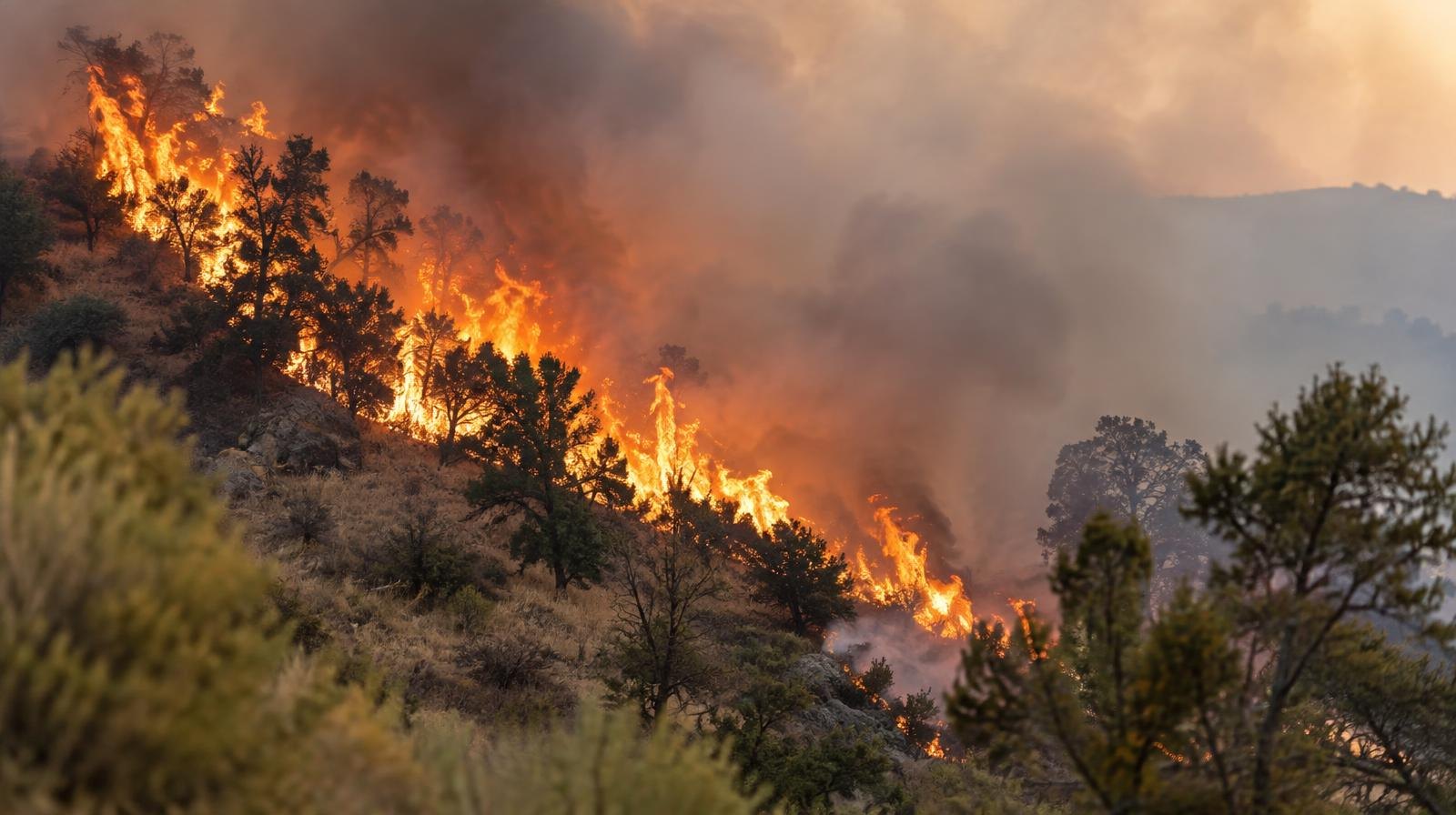
Utah's worst wildfire season in nearly two decades burned more than half a million acres statewide and hit Summit County directly, forcing the evacuation of Henefer in August.
The state recorded 1,028 wildfires and more than 553,000 acres burned as of late August, according to the Utah Division of Water Resources. J. Bradley Washa, an assistant professor of wildland fire science at Utah State University Extension, called it the most severe season since 2007 in a season review published by TownLift.
Six firefighters died.
The season destroyed at least 206 structures across six fires.
The Rocky Canyon Fire, which burned in Summit and Morgan counties, grew to an estimated 14,631 acres and was 23% contained as of Aug. 11, KPCW reported. Officials said the fire was human-caused, though the exact source remained under investigation.
On Aug. 10, officials ordered all residents west of Main Street in Henefer between East Canyon Road and South Henefer Road to evacuate immediately, according to KPCW. A temporary shelter opened at the LDS Chapel at 40 N. Main St. in Coalville. Henefer, population about 1,000, saw more than 150 homes or other buildings threatened, according to FEMA data cited by KSL. SR-66 and SR-65 from Henefer were closed.
Summit County Sheriff Kacey Bates spoke at a community meeting at North Summit High School in Coalville on Aug. 10 as the fire threatened the town.
"As your sheriff, I want everyone to know when it comes to evacuations, that I do not take that lightly," Bates said. "I know it's very serious, and I do not like displacing families."
A day earlier, on Aug. 9, a countywide "Go" evacuation alert was mistakenly sent to all Summit County residents. The county confirmed the alert was a system error and said only residents between the Summit County Line at Hog Back Summit and West Henefer Road were actually under evacuation, KUTV reported.
The human toll extended well beyond Summit County. Four wildland firefighters died in a burnover incident near the Utah-Colorado border. Three crew members died at the scene on June 27: Emily Barker, Nick Hutcherson and Sydney Watson. A fourth, Nathan Matthews, 43, of Lincoln, Nebraska, died July 25 from burn injuries sustained in the same incident, KSL reported. They were the first wildland firefighter fatalities associated with a Utah wildfire since 2006.
A pilot and a crew member were killed Aug. 7 when a Sikorsky S-64 helicopter crashed near Richfield while supporting the Widemouth 2 Fire, according to KSL.
Three of the season's fires rank among Utah's 10 largest since 2002: the Widemouth 2 Fire at 129,741 acres, the Babylon Fire at 107,189 acres and the Cottonwood Fire at 97,464 acres. The Cottonwood Fire alone destroyed 185 structures and forced Eagle Point Resort in Beaver County to cancel its 2026-27 ski season after the blaze damaged two lodges and four of five chairlifts.
Washa noted the season saw an unusual number of large fires starting in and spreading to higher-elevation forests, a shift from the historical pattern of Utah's largest fires burning in lower-elevation rangelands and Bureau of Land Management (BLM) lands. Lightning caused 54% of Utah wildfires in 2026, compared to a 10-year average of about 41%.
Even before the 2026 season's fires were fully out, the Beaver Canyon Fire ignited Jan. 22, 2027, near Strawberry Reservoir in Wasatch County, an area that would typically have been under several feet of snow, according to Washa.
The Great Basin Coordination Center's outlook calls for normal fire potential through the end of 2026, though Red Flag Warning days could temporarily raise risk. Looking into 2027, Washa pointed to a strengthening El Niño pattern that could increase snowpack and reduce drought in southern Utah.