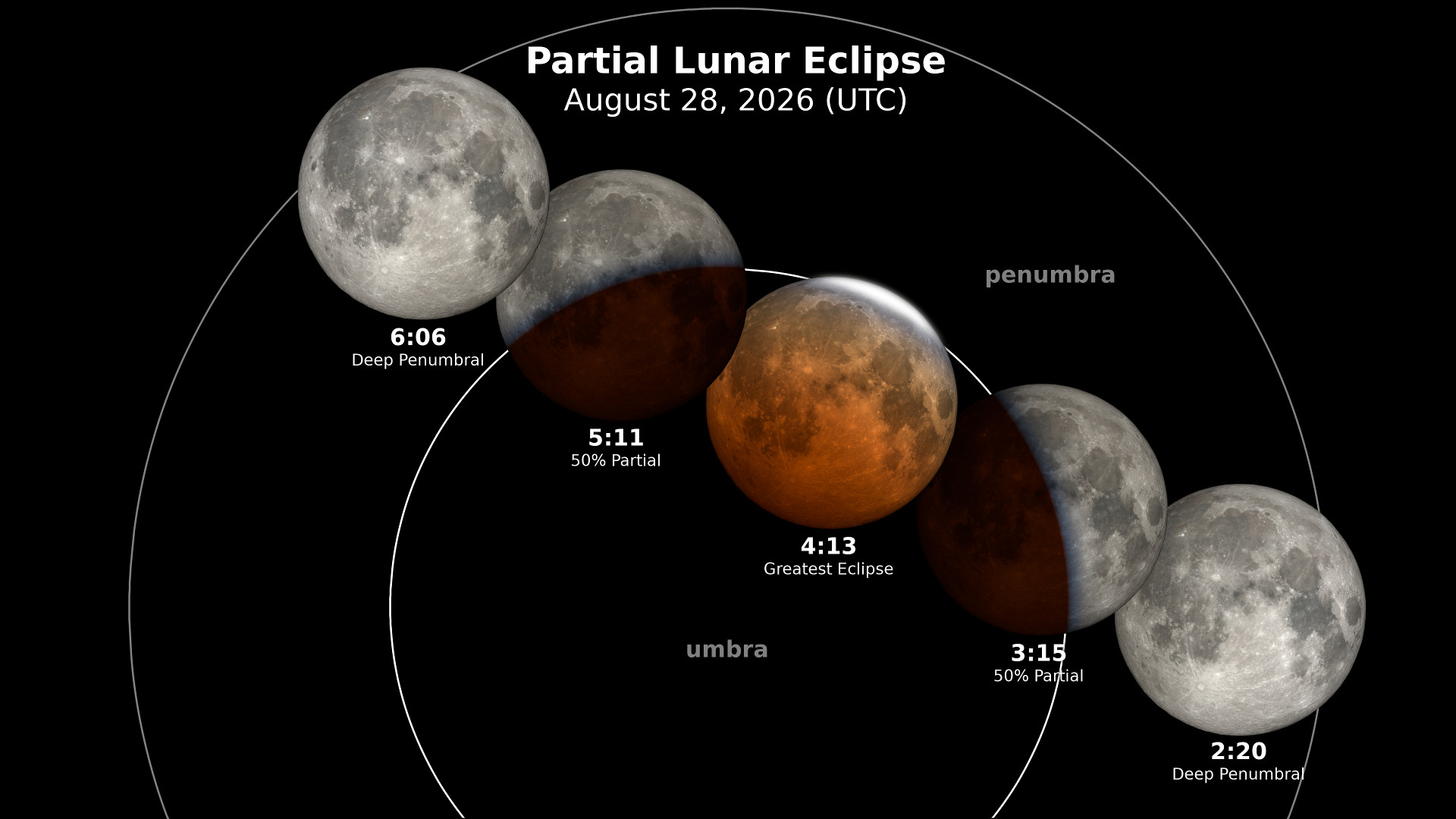
Park City residents who look up Thursday, Aug. 27, will see nearly all of the moon swallowed by Earth's shadow, with 96.3% of the lunar disk turning shades of copper and rust at the 10:13 p.m. peak.
The deep partial eclipse, confirmed by NASA's Goddard Space Flight Center, will be visible across the Americas from the evening of Aug. 27 into the early hours of Friday, Aug. 28. It's the most impressive lunar eclipse until a total eclipse on Dec. 31, 2028, according to Space.com.
When to watch
The best viewing window for Park City falls between about 9 p.m. and midnight. Here's the full timeline in Mountain time, as reported by TownLift:
- 8:34 p.m. Partial phase begins as the moon enters Earth's umbra
- 10:13 p.m. Maximum eclipse; 96.3% of the moon in shadow
- 11:52 p.m. Partial phase ends
- Shortly after 1 a.m. Friday, Aug. 28 Moon leaves the penumbra entirely
The entire event, penumbral and partial phases combined, lasts 5 hours and 38 minutes.
What you'll see
As the eclipse deepens, most of the moon will take on copper, rust or deep red tones. Earth's atmosphere bends red and orange light toward the lunar surface while scattering blue wavelengths, the same process that colors sunrises and sunsets.
A narrow bright sliver will remain directly lit throughout. That contrast may initially make the eclipsed portion appear nearly black, but as viewers' eyes adjust, the copper coloring should emerge, according to NASA. Fainter stars normally washed out by the full moon's glare may also become visible near the peak.
No special glasses or equipment are needed. Binoculars can provide a closer look at the advancing shadow.
Weather and where to go
The National Weather Service forecast for Thursday night calls for a 20% chance of showers and thunderstorms before midnight with mostly cloudy skies, a low around 58 degrees and light winds. Forecasts may shift before Thursday evening.
Park City's surrounding ridgelines can block views near the horizon during the early stages. An open location with a clear eastern view will help. Jordanelle State Park, a certified International Dark Sky Park just east of town, offers some of the area's darkest skies, particularly at its Rock Cliff Nature Area.
No organized public watch party in the Park City area was confirmed as of Wednesday, Aug. 26.
What's next
Thursday's eclipse is the final eclipse of 2026. The next lunar eclipse, a subtler penumbral event, won't arrive until Feb. 20-21, 2027.
At a glance
- What: Deep partial lunar eclipse (96.3% coverage)
- When: Thursday, Aug. 27, best viewing 9 p.m. to midnight; peak at 10:13 p.m.
- Where: Visible anywhere in Park City with a clear sky; Jordanelle State Park's Rock Cliff Nature Area for darker skies
- Gear: None required; binoculars optional